
MENU

“The great and chief end of government,” the philosopher John Locke wrote, “is the preservation of property.”
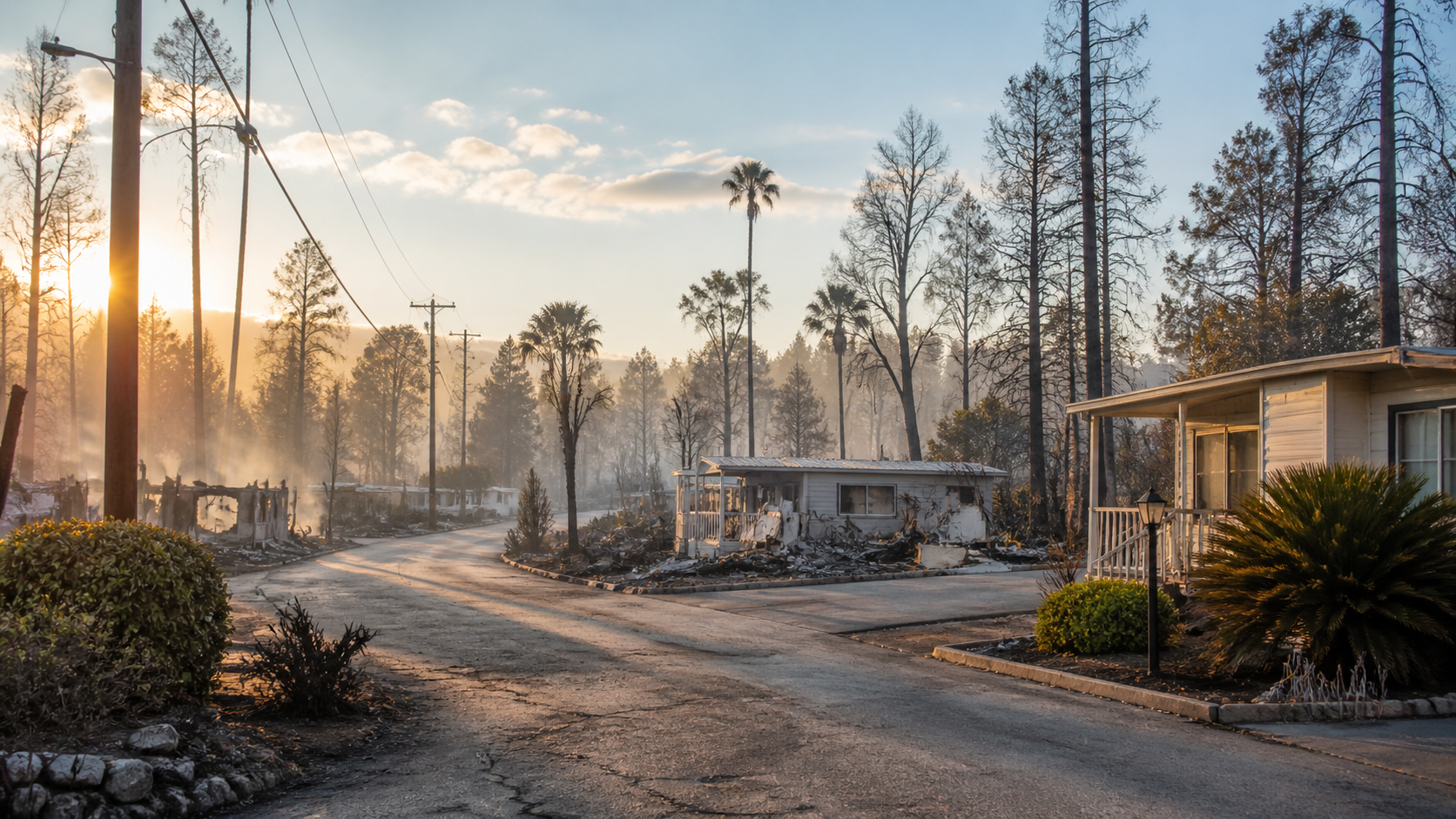
That principle sits at the foundation of American law. In the wake of California’s recent wildfires, questions have emerged regarding how property rights are affected when entire communities are destroyed. These questions have become particularly acute following disasters such as the 2018 Woolsey Fire, which displaced mobilehome residents across Malibu and the Santa Monica Mountains. A recent article titled “Disaster by Design: How California Quietly Stripped Mobilehome Owners of Their Rights After Wildfire” argues that lawmakers dismantled long-standing protections for mobilehome residents in the wake of those fires. While the article raises important concerns, its characterization of the legal framework does not fully reflect the current statutory structure.
The Legal Framework Governing Mobilehome Parks
Mobilehome parks in California are governed by the Mobilehome Residency Law (Civil Code § 798 et seq.), a detailed statutory framework that regulates eviction procedures, lease termination, and park management conduct.
This framework reflects the unique nature of mobilehome ownership. Unlike traditional tenants, residents typically own their homes but lease the land beneath them. Because relocating a mobilehome can be prohibitively expensive—and in some cases impractical—California law provides enhanced protections designed to prevent sudden displacement.
As a result, park owners must follow specific statutory procedures before terminating tenancies, converting park land to other uses, or removing residents. These protections are intended to address the very vulnerabilities that mobilehome residents face.
What Senate Bill 274 Actually Did
Much of the recent commentary focuses on legislation enacted after the major wildfire events of the late 2010s. In particular, Senate Bill 274 has been cited as a basis for claims that resident protections were weakened.
While some commentary suggests that resident protections were weakened, Senate Bill 274 introduced additional statutory protections in certain circumstances. Senate Bill 274 added Civil Code section 798.62, which addresses what happens when a mobilehome park is destroyed by wildfire or another natural disaster. Under this provision, if a park owner elects to rebuild, displaced homeowners must be offered renewed tenancy on substantially the same terms as their prior agreements.
In practical terms, the law creates a statutory right of return. If a destroyed park is rebuilt, former residents must be given the first opportunity to reoccupy their spaces.
Prior to the enactment of SB 274, no explicit statutory framework directly addressed re-tenancy rights following destruction of a park due to disaster. The legislation therefore represents a meaningful expansion of resident protections, rather than a reduction. This provision may be viewed as an expansion of protections in the specific context where rebuilding occurs.
When a Park Is Not Rebuilt
The more difficult legal and policy questions arise in a different scenario—when a mobilehome park destroyed by wildfire is not rebuilt.
In that situation, the outcome shaped by general principles of property law, rather than wildfire-specific statutory mandates. If a development is destroyed and the property owner elects not to reconstruct it, the physical premises that defined the tenancy no longer exist.
As a general matter, California law does not require a private property owner to rebuild a destroyed development, although local regulations and land use considerations may influence redevelopment decisions. The wildfire legislation recognizes this legal reality while addressing the circumstance in which rebuilding does occur, ensuring that displaced residents are given the opportunity to return.
Balancing Property Rights and Real-World Impacts
None of this minimizes the hardship wildfire victims face. Entire mobilehome communities have been destroyed in recent years, and rebuilding efforts are often delayed by infrastructure challenges, insurance disputes, and rising construction costs.
In some cases, property owners determine that rebuilding is not financially feasible. Those decisions can leave residents without the communities they once called home, raising significant policy concerns regarding housing stability and affordability.
These outcomes present difficult policy questions, but they do not necessarily reflect a statutory elimination of rights.
Looking Ahead
As wildfire-related disasters become more frequent across California, these issues are likely to arise with increasing regularity. They highlight the ongoing tension between property rights, redevelopment considerations, and broader housing policy concerns.
For property owners, developers, and investors, understanding how the Mobilehome Residency Law interacts with disaster recovery legislation and land use regulations is critical when evaluating post-disaster options.
The legal framework remains grounded in longstanding property law principles, while also incorporating statutory protections aimed at addressing displacement risks. In this context, California lawmakers have attempted—however imperfectly—to balance that principle with the realities of disaster recovery by ensuring that displaced residents have the opportunity to return when rebuilding occurs.
What This Means for Property Owners
For property owners and developers, these issues are not just theoretical—they can directly affect redevelopment decisions, timing, and long-term investment strategy.
In particular, owners of mobilehome parks or similar properties should carefully consider:
Understanding these issues early can help property owners avoid costly missteps and make more informed decisions in the aftermath of a disaster.
Understanding these issues early can help property owners avoid costly missteps and make more informed decisions in the aftermath of a disaster.
In the aftermath of catastrophic wildfires, California lawmakers have attempted to balance property rights with displacement concerns by providing certain statutory protections, including a right to return where rebuilding occurs. Whether those protections are sufficient remains an open policy question, but any analysis should begin with a clear understanding of the governing legal framework.
Source: The Current Report, Disaster by Design: How California Quietly Stripped Mobilehome Owners of Their Rights After Wildfire, March 5, 2026
G10 Law Real Estate & Land Use Group
Louis A. Galuppo, Esq. | Melania Mirzakhanian, Esq.
If you have questions regarding real estate development, land use compliance, or business matters affecting your property or company, the attorneys at G10 Law are available to assist. Our firm advises property owners, developers, and businesses throughout California on real estate, business, and banking matters. This blog post is provided for informational purposes only and does not constitute legal advice. Reading this post does not create an attorney-client relationship with G10 Law. You should consult with a qualified attorney regarding the specific facts and circumstances of your situation before making legal decisions.


